
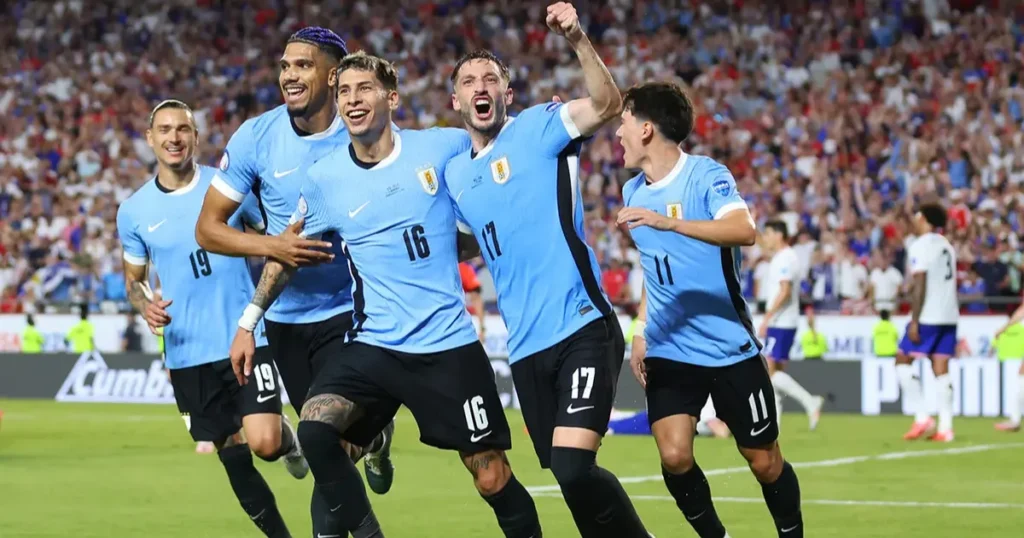
The Uruguay football team, often hailed as one of the true pioneers of the beautiful game, has etched its name into the annals of soccer history with a blend of grit, flair, and sheer audacity. Nicknamed La Celeste for their iconic sky-blue jerseys, this small South American nation punches way above its weight on the global stage. From hosting and winning the inaugural FIFA World Cup to shocking giants in packed stadiums, the Uruguay national football team embodies the raw emotion of the sport. If you’re a fan wondering about the Uruguay FIFA ranking or eagerly awaiting the Uruguay next match, buckle up—this deep dive into their storied journey will leave you chanting “¡Vamos Uruguay!” Whether you’re a die-hard supporter or a newcomer to the world of international soccer, understanding the Uruguay football team’s evolution reveals why they’re perennially a force to be reckoned with.
In a continent dominated by powerhouses like Brazil and Argentina, Uruguay’s success is nothing short of miraculous. With a population of just over three million, they’ve amassed more major international trophies than most nations could dream of. But it’s not just about silverware; it’s the heart-wrenching narratives, the underdog tales, and the electric atmosphere of their matches that make following the Uruguay football team so addictive. Let’s explore their rich tapestry, from humble beginnings to modern-day battles, all while keeping an eye on what lies ahead.
The Storied History of the Uruguay Football Team
The roots of the Uruguay football team trace back to the early 20th century, a time when soccer was exploding across South America. Their first official international match came in 1902 against arch-rivals Argentina—a 2-0 loss that stung but ignited a fire. By 1916, Uruguay had already claimed their inaugural South American Championship (now known as the Copa América), defeating hosts Argentina 2-0 in the final. This victory set the tone for a decade of dominance, as La Celeste would go on to win the tournament three more times between 1917 and 1923.
But it was the 1920s that catapulted the Uruguay football team into legend status. Inviting them to the 1924 Paris Olympics was a bold move by the organizers, who wanted to showcase the world’s best. Uruguay arrived late, their ship docking just in time, but they dismantled Europe’s finest: a 3-0 semifinal win over the Netherlands and a 2-1 final triumph over Switzerland. The lap of honor they performed afterward—circling the field to salute the crowd—became a tradition still observed today. Four years later, at the 1928 Amsterdam Olympics, they repeated the feat, edging Argentina 2-1 in a brutal final marred by fan riots.
These Olympic golds were more than medals; they were de facto world championships, as FIFA itself organized the tournaments and invited professional players. Uruguay’s style was revolutionary: fluid passing, relentless pressing, and a never-say-die attitude that foreshadowed modern high-intensity football. Their crowning glory came in 1930 when they hosted the first-ever FIFA World Cup at the newly built Estadio Centenario in Montevideo—a 100,000-seat marvel funded by national pride. Beating Peru 1-0 in the semis and hosts Argentina 4-2 in the final before a frenzied home crowd, Uruguay became the inaugural world champions. It was poetic justice after boycotting the 1930 edition? No—they hosted it as a reward for their Olympic exploits.
The post-war era brought highs and lows. The 1950 World Cup in Brazil remains etched in lore as the Maracanazo—Uruguay’s 2-1 upset over the hosts in the final, attended by a record 173,850 fans. Alcides Ghiggia’s goal in the 79th minute silenced the Maracanã, a moment so seismic it reportedly contributed to Brazil’s collective trauma. Yet, the 1954 World Cup quarterfinal loss to Hungary marked the end of an unbeaten streak in major tournaments dating back to 1924.
The 1970s and 1980s were leaner, with early Copa América exits and World Cup group-stage woes. A brief resurgence in the 1980s saw them win the 1981 Copa América, but it was the 1990s that reignited hope. Under coach Héctor Núñez, they reached the 1990 World Cup quarterfinals, only to fall to Italy amid controversy. The new millennium brought stability, with consistent World Cup qualifications and a golden generation emerging in the 2010s. Today, the Uruguay football team stands as a testament to resilience, blending historical reverence with contemporary ambition.
Major Achievements: Trophies That Define a Nation
What sets the Uruguay football team apart is their trophy cabinet, which rivals that of giants despite their size. FIFA recognizes four world titles: the 1924 and 1928 Olympic golds (counted as world championships at the time) and World Cup wins in 1930 and 1950. These adorn their crest with four stars, a point of pride that irks some rivals but delights fans.
In the Copa América, Uruguay reigns supreme with 15 titles—the most recent in 2011, when they defeated Paraguay on penalties in a tense final. That victory ended a 16-year drought and qualified them directly for the 2012 Confederations Cup. They’ve also clinched the 1980 Mundialito (World Champions’ Gold Cup), beating Brazil in a mini-World Cup for past winners. Add two Olympic silvers (1956, 1972) and a U-20 World Cup in 2023, and it’s clear why Uruguay is dubbed “football’s first global powerhouse” by FIFA.
These achievements aren’t just stats; they’re cultural milestones. The 1930 World Cup win unified a nation post-civil strife, while the Maracanazo healed wounds from earlier defeats. In a 2025 context, with the Uruguay FIFA ranking hovering around 14th, these legacies fuel their drive toward the 2026 World Cup.
To better understand the Uruguay football team’s dominance, here’s a comprehensive table of their major achievements:
| Competition | Titles | Years Won | Notable Highlights |
|---|---|---|---|
| FIFA World Cup | 2 | 1930, 1950 | Hosted and won inaugural edition; Shocked Brazil in Maracanazo final |
| Olympic Football | 2 | 1924, 1928 | Back-to-back golds; Started lap-of-honor tradition |
| Copa América | 15 | 1916, 1917, 1920, 1923–1924, 1926, 1935, 1942, 1956–1957, 1959–1960, 1967, 1983, 1987, 1995, 2011 | Most titles in history; 2011 win ended long drought |
| FIFA U-20 World Cup | 1 | 2023 | First youth World Cup title; Beat Italy in final |
| Mundialito | 1 | 1980 | Beat Brazil; Recognized as world champions’ showcase |
| Confederations Cup | 1 | 2011 (runners-up, but qualified via Copa) | Third place in 1997 and 2013 |
This table not only highlights their haul but also underscores patterns: early 20th-century supremacy transitioning to sporadic brilliance in the modern era. It’s a visual roadmap for readers to grasp why the Uruguay football team remains a benchmark for success against the odds.
Iconic Key Players: Heroes in Sky Blue
No discussion of the Uruguay football team is complete without its legends. José Nasazzi, the “Grand Marshal,” captained the 1930 World Cup side and the 1928 Olympics, embodying leadership with his tactical acumen. Obdulio Varela, skipper in 1950, rallied his team with a pre-Maracanazo speech: “If we win, we’ll be legends; if we lose, history will forget.” His calm under pressure was legendary.
The 2010s golden generation shone brightest. Diego Forlán, the elegant forward, won the 2010 World Cup Golden Ball for his semifinal heroics against Ghana. Luis Suárez, the talismanic striker, holds the national record with 68 goals in 133 caps—his bite controversies aside, his vision and finishing terrorized defenses. Edinson Cavani, the selfless poacher, complemented Suárez with tireless runs, amassing 14 Copa América goals.
Current stars carry the torch. Federico Valverde, Real Madrid’s midfield dynamo, brings explosive energy and long-range rockets; his 2025 form has him pegged as a Ballon d’Or contender. Darwin Núñez, Liverpool’s raw powerhouse, scores with ferocious intensity, netting 12 goals in qualifiers. Goalkeeper Rocío Rodríguez anchors the backline with cat-like reflexes, while Giorgian de Arrascaeta’s creativity in midfield adds flair. Emerging talents like U-20 World Cup hero Facundo Torres promise a seamless transition.
These players aren’t just athletes; they’re national icons. Suárez’s emotional farewell in 2024 tugged heartstrings, symbolizing the end of an era while heralding a new one.
Tactical Evolution: From Catenaccio to Bielsa’s Chaos
The Uruguay football team’s tactics have evolved dramatically. Early successes relied on garra charrúa—fierce, indigenous-inspired determination—with fluid 2-3-5 formations emphasizing attack. The 1950 side mixed this with defensive resilience, frustrating Brazil’s flair.
Post-1970s, they adopted Italian catenaccio influences, prioritizing solidity. Óscar Tabárez’s 2008-2020 tenure modernized this into a pragmatic 4-4-2: compact midfield, quick counters, and Suárez-Cavani synergy. They reached the 2010 World Cup semis and 2011 Copa final through disciplined pressing.
Since 2023, Marcelo Bielsa—the “Loco” known for high-pressing mania—has injected chaos. His 3-3-1-3 setup demands relentless intensity: full-backs bombing forward, midfielders swarming like bees, and Núñez as a battering ram. It’s high-risk—evident in 2025’s leaky defense—but exhilarating, yielding 70% possession in key wins. Bielsa’s man-to-man marking echoes Uruguay’s historical tenacity, tailored for 2026.
Critics note fatigue risks, but fans adore the spectacle. This tactical shift keeps the Uruguay FIFA ranking competitive, blending heritage with innovation.
Recent Results: A Rollercoaster Ride in 2025
2025 has been a mixed bag for the Uruguay football team, blending qualification triumphs with friendly stumbles. In CONMEBOL World Cup qualifiers, they secured their 2026 spot early with 28 points from 14 matches—five wins, three draws, two losses in the reported stretch. Standout results included a 2-0 home thrashing of Brazil in September, where Valverde’s screamer and Núñez’s header sealed glory, and a gritty 0-0 draw in Chile that showcased defensive grit.
However, cracks appeared in friendlies. On November 15, they edged Mexico 2-1 in a tense affair, with de Arrascaeta’s late equalizer turning the tide. Just three days later, disaster struck: a humiliating 1-5 loss to the USA in Tampa. Giorgian de Arrascaeta’s stunning overhead kick was Uruguay’s lone highlight amid U.S. dominance—Giovanni Reyna and Alex Freeman ran riot, exposing midfield frailties. Bentancur’s red card compounded woes, dropping morale ahead of qualifiers’ resumption.
Overall, 2025’s form graph shows promise: 1.2 goals scored per game but 0.7 conceded, per stats. These results highlight Bielsa’s high-wire act—brilliant highs, punishing lows—but keep the Uruguay next match buzz alive.
Upcoming Fixtures: Eyes on the Uruguay Next Match
With 2026 World Cup qualification locked, the Uruguay football team’s calendar shifts to fine-tuning. The Uruguay next match post-November friendlies is a March 21, 2025, qualifier against Argentina— a Clásico del Río de la Plata clash that could redefine rivalries. Expect fireworks at Estadio Centenario, where La Celeste boasts an unbeaten streak since 2022.
Round 14 follows on March 25 away to Bolivia, a high-altitude test in La Paz that demands acclimatization. June brings Round 15 (home vs. Peru) and Round 16 (away to Ecuador), crucial for seeding. Beyond qualifiers wrapping in September 2025, friendlies against European sides like Portugal loom, prepping for the World Cup draw.
The real prize? The expanded 2026 tournament in North America, where Uruguay joins 47 others. Group-stage potential opponents include hosts USA or Mexico—echoing November’s lessons. Fans are already dreaming of a deep run, with the Uruguay next match against Messi-less Argentina a tantalizing appetizer.
Fan Culture: The Heartbeat of La Celeste
Uruguay football team supporters are a breed apart—passionate, poetic, and unyieldingly loyal. Montevideo’s streets pulse with sky-blue fervor; murals of Suárez and Forlán adorn walls, while candombe drums echo during matchdays. The tricolores—barristas from clubs like Peñarol and Nacional—infuse national games with tribal energy, their chants like “¡Ohhh, qué lindo es mi Uruguay!” shaking stadiums.
Estadio Centenario, the “Temple of Football,” is sacred ground: site of the 1930 triumph, it hosts qualifiers with 60,000 roaring fans. Away days are epics—thousands traveling to Buenos Aires for derbies, enduring taunts with defiant songs. Women’s support has surged, with groups like Celestes Femeninas breaking barriers.
Social media amplifies this: #LaCeleste trends globally, memes of the Maracanazo go viral. Yet, it’s the quiet rituals—families gathering around radios, as in 1950—that bind generations. In a nation where football is religion, fans are the high priests, turning defeats into defiance.
Future Outlook: Charting the Path to 2026 Glory
As 2025 closes, the Uruguay football team’s horizon gleams with possibility. At 14th in the Uruguay FIFA ranking, they’re outsiders for the 2026 World Cup but brimming with talent. Bielsa’s contract runs through the tournament; his pressing philosophy could overwhelm in the expanded format, where third-place group exits advance.
Challenges loom: aging stars like Cavani’s retirement leaves voids, and defensive lapses (conceding 1.5 goals per friendly) need plugging. Youth integration—Torres, midfielder Manuel Ugarte—promises depth. A strong Copa América 2024 hangover? No; qualifiers proved resilience.
By 2030, expect a top-10 FIFA perch if Núñez hits 50 caps and Valverde leads. The Uruguay football team isn’t just surviving; they’re evolving, ready to add another star. For now, all eyes on the Uruguay next match—because in Celeste blue, miracles happen.
In wrapping this journey, the Uruguay football team reminds us: size doesn’t define destiny. From 1930’s glory to 2025’s grit, La Celeste inspires. Whether tracking the Uruguay FIFA ranking or hyped for the next clash, their story is ours—fierce, flawed, and forever captivating. What’s your favorite Uruguay moment? Share in the comments; ¡Arriba Uruguay!